Walking After 40: Is It Enough?
by Megan Fain, PT
Founder, Power Reset Path
Last Reviewed August 2026
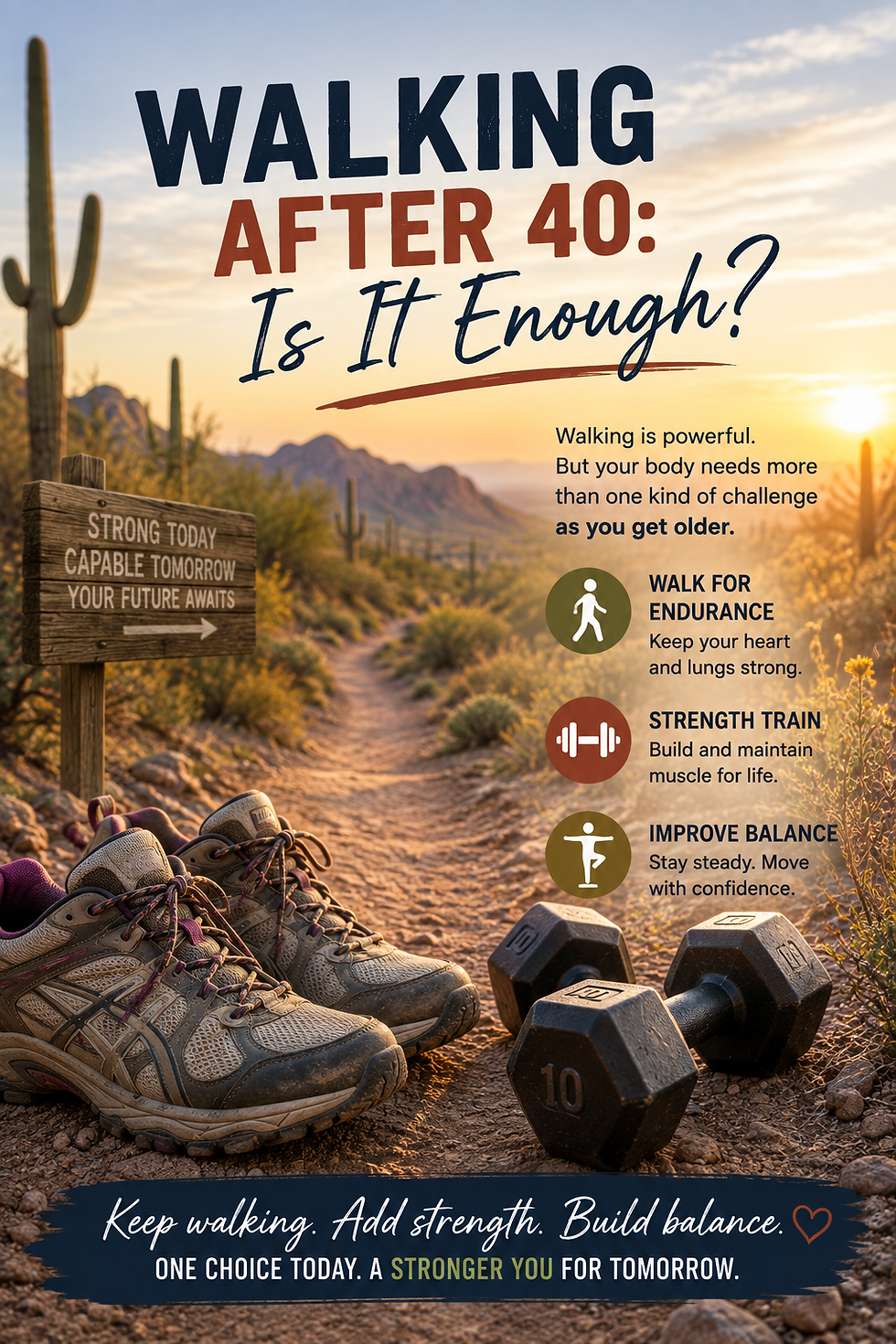
Let’s start by settling something.
Walking counts.
It absolutely counts.
You don’t have to run.
You don’t have to sweat through a boot camp.
You don’t have to leave every workout wondering whether your legs will function tomorrow.
Walking is accessible, practical, inexpensive and something many women can continue doing throughout their lives.
So if you’ve been told walking “isn’t really exercise,” you can let that one go.
But there’s another question worth asking:
Does walking give your body everything it needs as you get older?
Usually, not quite.
And that’s not an argument to walk less.
It’s an invitation to add more.
Walking Is Real Exercise
Walking can absolutely be aerobic exercise.
Depending on your pace and effort, it can help you accumulate the moderate-intensity physical activity recommended for adults.
Regular physical activity supports cardiovascular health, sleep, mobility, mental health and overall healthy aging.
And walking has one enormous advantage:
People actually do it.
You can walk around your neighborhood.
On a treadmill.
Through a store.
With your dog.
With a friend.
On a trail.
For ten minutes.
For an hour.
It fits into real life.
And the activity you consistently do is far more valuable than the theoretically perfect workout you never begin.
Does Every Walk Count as Moderate Exercise?
All movement matters.
But not every walk has the same training effect.
A slow stroll and a brisk walk are both movement, but they place different demands on your body.
One simple way to estimate intensity is the talk test.
During moderate-intensity activity, your breathing and heart rate increase, but you can generally still carry on a conversation.
At vigorous intensity, talking becomes more difficult and you may only manage a few words before needing another breath.
You don’t need to turn every walk into a fitness test.
But if you’re using walking specifically to build aerobic fitness, intensity matters.
So How Much Aerobic Activity Do We Need?
Current U.S. physical activity guidelines recommend that adults work toward at least:
150 to 300 minutes of moderate-intensity aerobic activity each week
or
75 to 150 minutes of vigorous-intensity activity
or an equivalent combination of the two.
If you’re currently doing very little, don’t let those numbers discourage you.
You don’t have to go from zero to 150 minutes tomorrow.
Some physical activity is better than none.
Start where you are and build.
A ten-minute walk is not worthless because it wasn’t 30 minutes.
It was ten minutes you moved.
Do it again.
Then Why Isn’t Walking “Enough”?
Because your body needs more than one type of physical challenge.
Walking primarily gives us an aerobic and weight-bearing activity.
That’s valuable.
But as we age, we also want to deliberately maintain things like:
Muscular strength.
Muscle mass and function.
Balance.
The ability to produce and control force.
Think about everyday life.
Walking helps you get across the parking lot.
Strength helps you lift the groceries when you get there.
Walking helps you travel through the airport.
Strength helps you put your suitcase overhead.
Walking gets you to the trail.
Strength and balance help you manage the uneven terrain.
These abilities work together.
Walking and Strength Training Aren’t Competitors
Sometimes fitness advice makes women feel like they have to choose a team.
Cardio or weights.
Walking or lifting.
Endurance or strength.
You don’t.
Your body benefits from different kinds of demands.
Walking can support your aerobic fitness.
Resistance training challenges your muscles to maintain and develop strength.
Balance work challenges your ability to maintain stability and control.
One doesn’t make the others unnecessary.
They complement each other.
“But I Walk Hills”
Excellent.
Keep doing it.
Walking uphill increases the demand on your cardiovascular system and muscles compared with walking on level ground.
Hiking can add even more challenge depending on terrain, elevation and pace.
That doesn’t make it identical to progressive resistance training.
Remember what we discussed in our strength articles:
To build strength, muscles need an appropriate resistance challenge that can progress as your body adapts.
Walking hills may challenge your legs.
Strength training allows us to deliberately and progressively challenge muscles in ways ordinary walking may not.
You don’t need to choose one.
Do both.
What About Walking With Weights?
You may have seen weighted vests or “rucking” become popular.
Adding external load can increase the demands of walking.
But more weight isn’t automatically better, and carrying weight isn’t necessary to make walking worthwhile.
If you want to use a weighted vest or backpack, the appropriate load depends on your health, experience, balance, joint tolerance and goals.
For many women, especially beginners, there’s a simpler option:
Walk for walking.
Strength train for strength.
We don’t have to make every activity accomplish every goal.
Don’t Ruin Walking by Trying to Optimize It
This may be my favorite part.
If your walk is the 20 minutes when nobody needs anything from you…
Keep it.
If it’s when you listen to music…
Keep it.
If it’s when you call your sister…
Keep it.
If it’s when you watch the sunrise…
Please keep it.
Health isn’t created only through perfectly optimized exercise sessions.
Walking can be movement.
Training.
Transportation.
Thinking time.
Social time.
Outdoor time.
Or simply a few minutes when you get to belong to yourself.
It doesn’t have to become another thing you have to perform perfectly.
A Better Question Than “Is Walking Enough?”
Instead of asking:
“Does walking count?”
Yes.
Instead of asking:
“Should I stop walking and start lifting?”
No.
Try asking:
“What does my body need in addition to the movement I already enjoy?”
Maybe you’re already walking regularly.
Fantastic.
Now add two days of strength training.
Maybe you strength train but barely move during the rest of your day.
Add walks.
Maybe you’ve been inactive for years.
Start walking for five or ten minutes.
Then build.
Maybe balance is becoming more challenging.
Add appropriate balance work.
We’re not trying to replace something good.
We’re building around it.
What Could a Week Actually Look Like?
It doesn’t have to be complicated.
Maybe you walk most days because you enjoy it.
Then twice during the week, you add a simple full-body strength session.
As you get older, you can also intentionally include balance activities.
Some activities can even overlap.
Hiking may challenge endurance and balance.
Carrying groceries involves strength while you’re moving.
Gardening may involve movement, lifting and carrying.
Your body doesn’t know whether something happened inside a gym.
It responds to what you ask it to do.
The Goal Is Capacity
Once again, we’re moving away from exercise as punishment.
We’re not walking because we ate dessert.
We’re not lifting weights because we need to make ourselves smaller.
We’re building capacity.
Capacity to walk farther.
Carry more.
Climb stairs.
Travel.
Hike.
Garden.
Recover from a stumble.
Get off the floor.
Keep doing things for ourselves.
And hopefully keep doing many of the things we love.
Walking can be an incredible part of that.
It just doesn’t have to carry the entire job by itself.
Keep Walking. Then Build Around It.
If walking is the movement you love, I don’t want you to stop.
I want you to protect it.
Enjoy it.
Use it.
And then ask:
What else would help this body stay capable?
Maybe the answer is strength.
Maybe it’s balance.
Maybe it’s a little more aerobic challenge.
Maybe it’s simply becoming more consistent.
You don’t have to overhaul everything.
Keep what’s working.
Then add what you’re missing.
One choice at a time.
⸻
Ready for Your Next Step?
We’ve talked a lot about what your body needs.
But Power Reset Path isn’t ultimately about trying to recreate the woman you used to be.
It’s about discovering who you’re becoming.
→ Read next: You Don’t Need to Become Your Old Self Again
About the Author
Megan Fain, PT is a physical therapist, health educator, and founder of Power Reset Path. With more than 15 years of experience in healthcare, Megan brings a physical therapist’s perspective to movement, strength, mobility and lifelong physical function.
Her approach focuses on helping women build movement into real life — not simply exercise for exercise’s sake — so they can develop the strength, endurance and capacity to continue doing the things that matter to them.
She founded Power Reset Path on the belief that every woman, at every age, has an innate power to transform the world around her. Sometimes we just need help seeing it.
A Note From Power Reset Path
This article provides general educational and wellness information and isn’t individualized medical, physical therapy or exercise advice.
Appropriate physical activity depends on your health, current activity level, injuries, medications, balance and individual abilities. If you have a medical condition, significant pain, osteoporosis, balance concerns or other factors affecting your ability to exercise safely, talk with an appropriately qualified healthcare professional about recommendations specific to you.
References & Further Reading
U.S. Department of Health and Human Services
Physical Activity Guidelines for Americans, 2nd Edition
Evidence-based recommendations for aerobic and muscle-strengthening physical activity, including 150–300 minutes of moderate-intensity aerobic activity and muscle-strengthening activity on at least two days per week for adults.
National Institute on Aging (NIH)
Three Types of Exercise Can Improve Your Health and Physical Ability
Information about aerobic, muscle-strengthening and balance exercise and why a combination of activity types supports healthy aging.
National Institute on Aging (NIH)
Health Benefits of Exercise and Physical Activity
Information about physical activity, healthy aging, sleep, cardiovascular health and maintaining physical function.
National Institute on Aging (NIH)
How Can Strength Training Build Healthier Bodies as We Age?
Information about age-related changes in muscle and the role of strength training, walking and physical activity in maintaining mobility and independence.
American College of Sports Medicine (ACSM)
Resistance Training Prescription for Muscle Function, Hypertrophy, and Physical Performance in Healthy Adults (2026)
Current evidence-based guidance regarding resistance training, progression, individualization and physical performance.


Comments