You Don’t Need to Become Your Old Self Again
by Megan Fain, PT
Founder, Power Reset Path
Last Reviewed August 2026

I just want to feel like myself again.
It’s something women say about perimenopause all the time.
And it makes sense.
When your sleep changes, your body feels different, your patience seems shorter, your concentration isn’t what it used to be, or you simply don’t feel quite like yourself, of course you might look backward.
Back to the woman who had more energy.
Back to the body you recognized.
Back to when things felt easier.
Back to her.
But what if getting her back isn’t actually the goal?
What if there is nothing behind you that you’re supposed to return to?
What if the path is forward?
It Makes Sense to Miss Who You Were
Before we talk about becoming, I want to make room for something else.
Grief.
Not necessarily dramatic grief.
Sometimes it’s simply the quiet realization that a season of your life has ended.
Maybe you miss your younger body.
Your energy.
Your fertility.
Your confidence.
Your patience.
A relationship.
A version of motherhood.
Children who needed you differently.
A career you thought you’d have.
A life you thought would look different by now.
Or maybe you can’t even name what you miss.
You just know something has changed.
You don’t have to pretend every change feels empowering.
Some changes are hard.
Some deserve to be acknowledged before we rush to turn them into a lesson.
Perimenopause Can Make Change Harder to Ignore
Perimenopause is a normal biological transition leading to menopause.
Hormone levels fluctuate, menstrual cycles can change, and women may experience symptoms including hot flashes, sleep problems, mood changes, difficulty concentrating, vaginal and urinary symptoms, and other changes.
Not every woman experiences the transition the same way.
Some have few symptoms.
Others have symptoms that significantly affect daily life.
But perimenopause also tends to arrive during a stage of life when plenty of other things may be changing too.
Children grow.
Parents age.
Relationships evolve.
Careers shift.
Bodies change with age.
Responsibilities accumulate.
Priorities become harder to ignore.
So sometimes it can be difficult to separate:
What is perimenopause?
from
What is midlife?
from
What is simply my life asking me to pay attention?
You don’t have to figure all of that out today.
But you can become curious about it.
Stop Asking, “How Do I Get Back?”
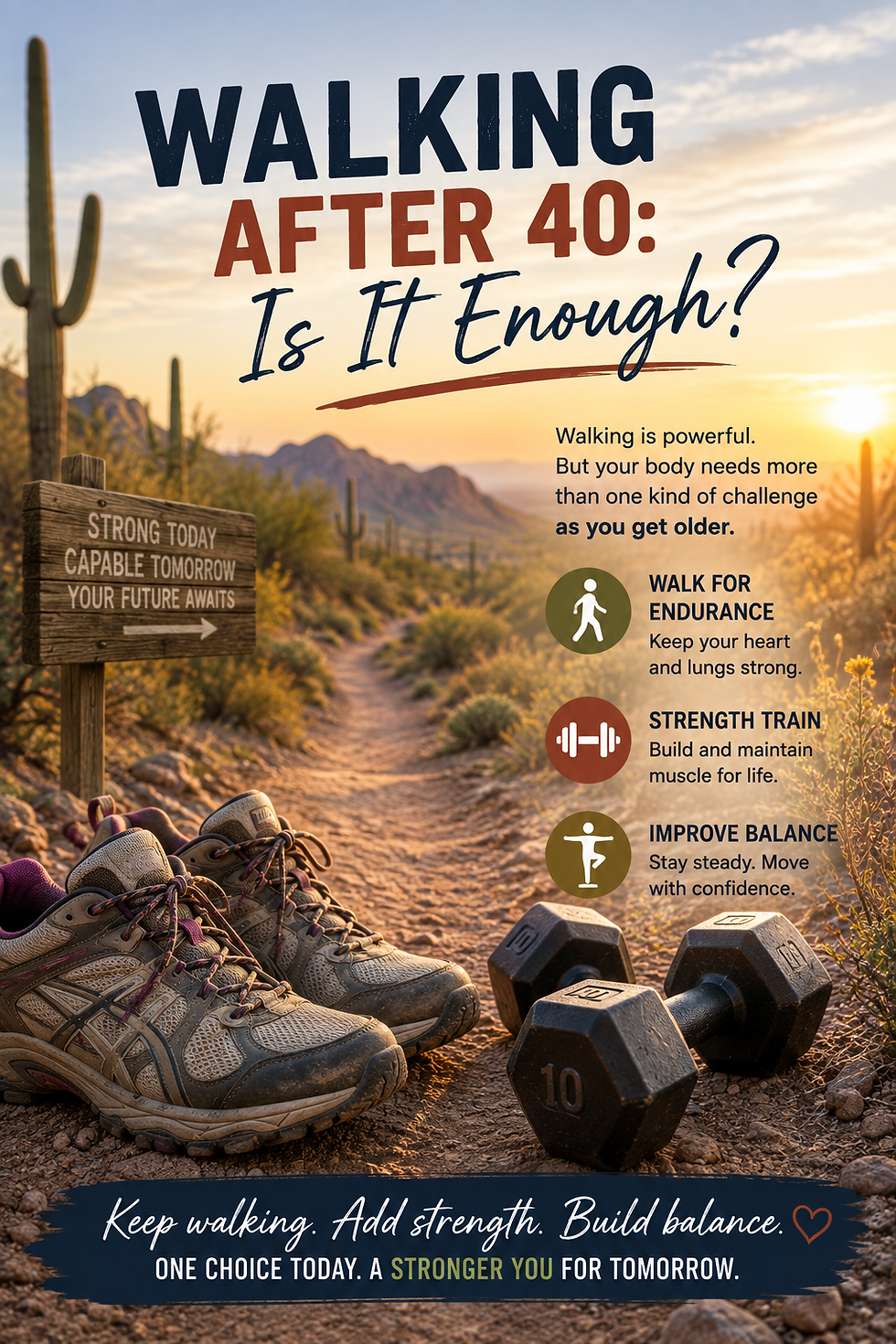
Imagine you’re walking a trail.
You arrive at a fork.
Behind you is everything you’ve already traveled through.
Everything you’ve learned.
Everything you’ve survived.
Everything you’ve loved.
Everything you’ve lost.
Everything you’ve become because of it.
One path says:
RETURN TO WHO I WAS.
The other says:
BECOME WHO I’M BECOMING.
Which one actually exists?
You can’t go backward and become 32 again.
And even if you could restore every ounce of energy, every hormone level, every pound, every relationship and every circumstance…
You still wouldn’t be the same woman.
You know too much now.
You’ve lived too much.
You’ve changed.
That isn’t failure.
That’s life.
The Old You Got You Here
I don’t want you to reject the woman you used to be.
Honor her.
She made choices with the information she had.
She survived things you once thought you couldn’t.
She loved people.
She made mistakes.
She learned.
She carried responsibilities.
She probably put herself last more times than you can count.
She got you here.
But she was never supposed to be the final version of you.
None of us are.
Growth requires us to keep becoming.
Maybe the Question Isn’t “What’s Wrong With Me?”
This question can quietly follow women through perimenopause:
What is wrong with me?
Why can’t I handle things like I used to?
Why am I more irritated?
Why can’t I remember everything?
Why doesn’t my body respond the same way?
Why don’t I want the same things?
Some of those questions may have medical answers.
Symptoms deserve appropriate evaluation and treatment when they’re affecting your life.
But not every difference needs to become evidence that something is wrong with you.
Sometimes a better question is:
What has changed?
Then:
What do I need now?
And eventually:
Who do I want to become from here?
Those questions lead somewhere very different.
You Are Allowed to Need Different Things Now
Maybe the strategies that worked at 30 don’t work at 47.
That doesn’t mean you failed.
Your body may need different support.
Your schedule may need different boundaries.
Your relationships may require different conversations.
Your exercise may need to change.
Your nutrition may need more intention.
Your recovery may matter more.
Your definition of success may even change.
Growth doesn’t always mean doing more.
Sometimes growth looks like finally recognizing what isn’t working anymore.
Information Gives You Choices
This is one reason education matters so much during perimenopause.
When you don’t understand what’s happening, every change can feel personal.
Why can’t I sleep?
Why am I suddenly so hot?
Why can’t I concentrate?
Why does my body feel different?
Learning doesn’t make every symptom disappear.
But understanding can give you language.
Language gives you better questions.
Better questions can lead to better conversations with healthcare professionals, more informed decisions, and more intentional choices in your own life.
That’s power.
Not controlling everything that happens.
Knowing you have choices in how you respond.
You Don’t Have to Fix Everything at Once
This is where transformation gets unnecessarily overwhelming.
You decide you’re going to change your life.
So Monday morning you’re going to:
Wake up at 5:00.
Meditate.
Journal.
Drink more water.
Eat perfectly.
Hit your protein target.
Lift weights.
Walk 10,000 steps.
Fix your sleep.
Reduce stress.
Set boundaries.
And apparently become an entirely new human before breakfast.
No.
Pick something.
One thing.
Ask:
What is one choice that supports the woman I’m becoming?
Then make it.
And practice making it again.
Transformation isn’t one giant decision.
It’s often a series of very ordinary choices made in the same direction.
Your Future Self Is Being Built Right Now
The woman you’ll be five years from now isn’t waiting somewhere for you to discover her.
You’re building her.
When you choose to go for the walk.
When you learn to strength train.
When you ask for help.
When you make the appointment you’ve been putting off.
When you protect your sleep.
When you eat in a way that supports your body.
When you say no.
When you say yes.
When you learn something new.
When you change your mind.
When you decide something matters enough to try again.
These choices may feel small while you’re making them.
But small choices repeated over time become direction.
And direction changes where the path leads.
Maybe You Don’t Need Your Old Confidence Either
Sometimes we think:
I used to be so confident.
But maybe what you need isn’t old confidence.
Maybe you need confidence built from who you are now.
Confidence that says:
I’ve been through things.
I’ve learned.
I’ve changed.
I can listen to myself.
I can ask questions.
I can make a decision.
I can change direction.
I can learn what I don’t know.
I can begin again without starting over.
That’s a different kind of confidence.
It isn’t based on everything staying predictable.
It’s built on trusting yourself when it doesn’t.
You Are Not Starting Over
This distinction matters.
Starting over suggests everything before this was wasted.
It wasn’t.
You’re starting from experience.
From lessons.
From scars.
From successes.
From mistakes.
From wisdom.
From a much clearer understanding of what matters — or at least a growing willingness to find out.
You don’t arrive at this part of life empty-handed.
You bring everything you’ve lived with you.
The question is what you choose to carry forward.
What Can Stay Behind?
At some point, every path requires us to decide what we’re carrying.
Maybe you’re ready to leave behind:
The belief that taking care of yourself is selfish.
The idea that exercise only matters if it changes your size.
The expectation that you should be able to do everything.
The habit of ignoring what your body is telling you.
The need to be who everyone else expects.
The belief that changing direction means you failed.
The idea that your best years must already be behind you.
You don’t have to carry everything simply because you’ve carried it for a long time.
What Do You Want to Carry Forward?
Your strength.
Your curiosity.
Your humor.
Your wisdom.
Your relationships.
Your experience.
Your courage.
Your ability to learn.
Your willingness to change.
Your capacity to care deeply.
Your dreams — including the ones you haven’t admitted out loud yet.
And maybe something you haven’t given yourself enough credit for:
The woman you already are.
The Path Doesn’t Have to Be Clear Yet
Sometimes we think transformation requires knowing exactly where we’re going.
It doesn’t.
You may only be able to see the next few feet of the trail.
That’s enough.
You don’t need a perfect five-year plan.
You don’t need to know exactly who you’re becoming.
You just need enough awareness to ask:
Which direction feels more aligned with the life I want to build?
Then take the next step.
Notice what you learn.
Adjust.
Choose again.
This Is the Power Reset
A reset doesn’t mean erasing everything and returning to factory settings.
It means stopping long enough to notice where you are.
Understanding what’s happening.
Deciding what matters.
And intentionally choosing what comes next.
That’s the heart of Power Reset Path.
Not becoming younger.
Not becoming smaller.
Not becoming who you were before perimenopause showed up.
Becoming more fully yourself.
Stronger where you want strength.
Softer where you no longer need armor.
Wiser because you’ve lived.
Curious enough to keep learning.
Brave enough to change direction.
And increasingly intentional about the life you’re creating.
There isn’t one correct path.
There is simply the next choice.
And then another.
And another.
You don’t need to become your old self again.
Honor her.
Thank her.
Bring everything she taught you.
Then turn toward the path ahead.
Because your next chapter isn’t behind you.
It’s the one you’re building now.
⸻
Ready for Your Next Step?
You’ve spent enough time wondering whether you can get the old you back.
Let’s start getting curious about the woman ahead.
Take a few quiet minutes and ask yourself:
What am I ready to leave behind?
What do I want to carry forward?
What is one choice I can make today for the woman I’m becoming?
Then make that choice.
Your transformation doesn’t begin someday.
It begins with your next one.
About the Author
Megan Fain, PT is a physical therapist, health educator, and founder of Power Reset Path. With more than 15 years of experience in healthcare and additional training in functional nutrition, Megan’s work extends beyond individual symptoms to the bigger question of how women want to live, move and grow through midlife and beyond.
Power Reset Path combines evidence-based education with practical tools for movement, nutrition, recovery, mindset and personal growth — helping women better understand what’s happening in their bodies while becoming more intentional about what comes next.
Megan founded Power Reset Path on the belief that every woman, at every age, has an innate power to transform the world around her.
Sometimes we just need help seeing it.
A Note From Power Reset Path
Power Reset Path provides educational and general wellness information. This article isn’t a substitute for individualized medical, mental health, nutrition or physical therapy care.
Perimenopause and menopause can involve physical and emotional symptoms that deserve appropriate evaluation and treatment. Persistent depression, anxiety, significant sleep problems, abnormal bleeding or other symptoms affecting your health or daily life should be discussed with an appropriately qualified healthcare professional.
Personal growth and mindset practices can complement appropriate healthcare, but they aren’t substitutes for medical or mental health treatment.
References & Further Reading
National Institute on Aging (NIH)
What Is Menopause?
Evidence-based information about the menopausal transition, individual variation in symptoms, mood and concentration changes, healthy aging, and health after menopause.
National Institute on Aging (NIH)
Research Explores the Impact of Menopause on Women’s Health and Aging
An overview of research examining the biological, psychological and social changes women experience during midlife and the menopausal transition.
Office on Women’s Health, U.S. Department of Health and Human Services
Menopause Basics
Current information about perimenopause, changing hormone levels, menstrual changes and the wide variation in women’s experiences of the menopause transition.
Office on Women’s Health, U.S. Department of Health and Human Services
Menopause Symptoms and Relief
Information about sleep, mood, concentration, physical symptoms and treatment options during perimenopause and menopause.
American College of Obstetricians and Gynecologists (ACOG)
The Menopause Years
Evidence-based patient education about perimenopause, menopause, symptoms and treatment.


Comments