Why Strength Training Matters More as We Get Older
- Megan Fain, PT
- Aug 11
- 7 min read
by Megan Fain, PT
Founder, Power Reset Path
Last Reviewed August 2026
For years, women were handed a pretty simple exercise message:
Eat less. Move more. Burn calories.
Walk farther.
Do more cardio.
Make your body smaller.
But what if one of the most important things we can do as we get older isn’t about making ourselves smaller at all?
What if it’s about becoming stronger?
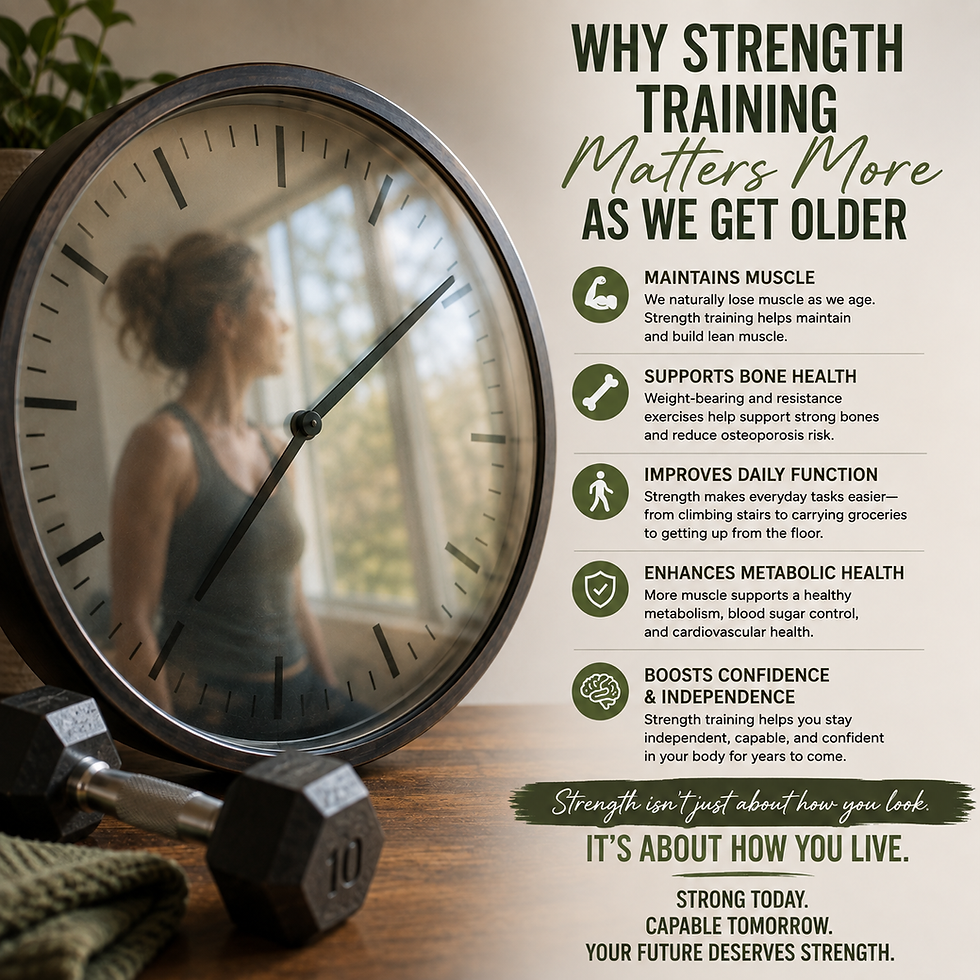
Muscle Is About Much More Than Appearance
When you hear “strength training,” you may picture a gym.
Heavy barbells.
Muscles.
Someone grunting loudly enough for the entire building to hear.
But strength is much more ordinary — and much more important — than that.
Strength is carrying groceries into the house.
Getting a suitcase into an overhead bin.
Getting yourself up from the floor.
Working in the garden.
Climbing stairs.
Hiking.
Picking up a child.
Maintaining your balance when you stumble.
Continuing to do things for yourself.
Muscle isn’t simply something we build for the gym.
We build it for life.
We Naturally Lose Muscle as We Age
As we get older, we tend to gradually lose muscle mass and strength.
That loss can eventually affect mobility, physical function and our ability to independently do the things that matter to us.
For women, midlife also brings the menopause transition.
And after menopause, lower estrogen levels contribute to accelerated bone loss, making bone health another important part of the conversation.
That makes this an especially valuable time to pay attention to strength.
Not because your body is failing.
Because you’re building the body you’ll be living in for the decades ahead.
Your Body Responds to What You Ask of It
This is one of my favorite things about the human body.
It’s adaptable.
When you appropriately challenge muscle, you’re essentially giving your body information:
I need to be able to do this.
Your body responds to resistance by adapting to the demands placed upon it.
Over time, appropriately progressed resistance training can improve muscular strength and help maintain or increase muscle.
That’s why simply being active and intentionally training for strength aren’t always the same thing.
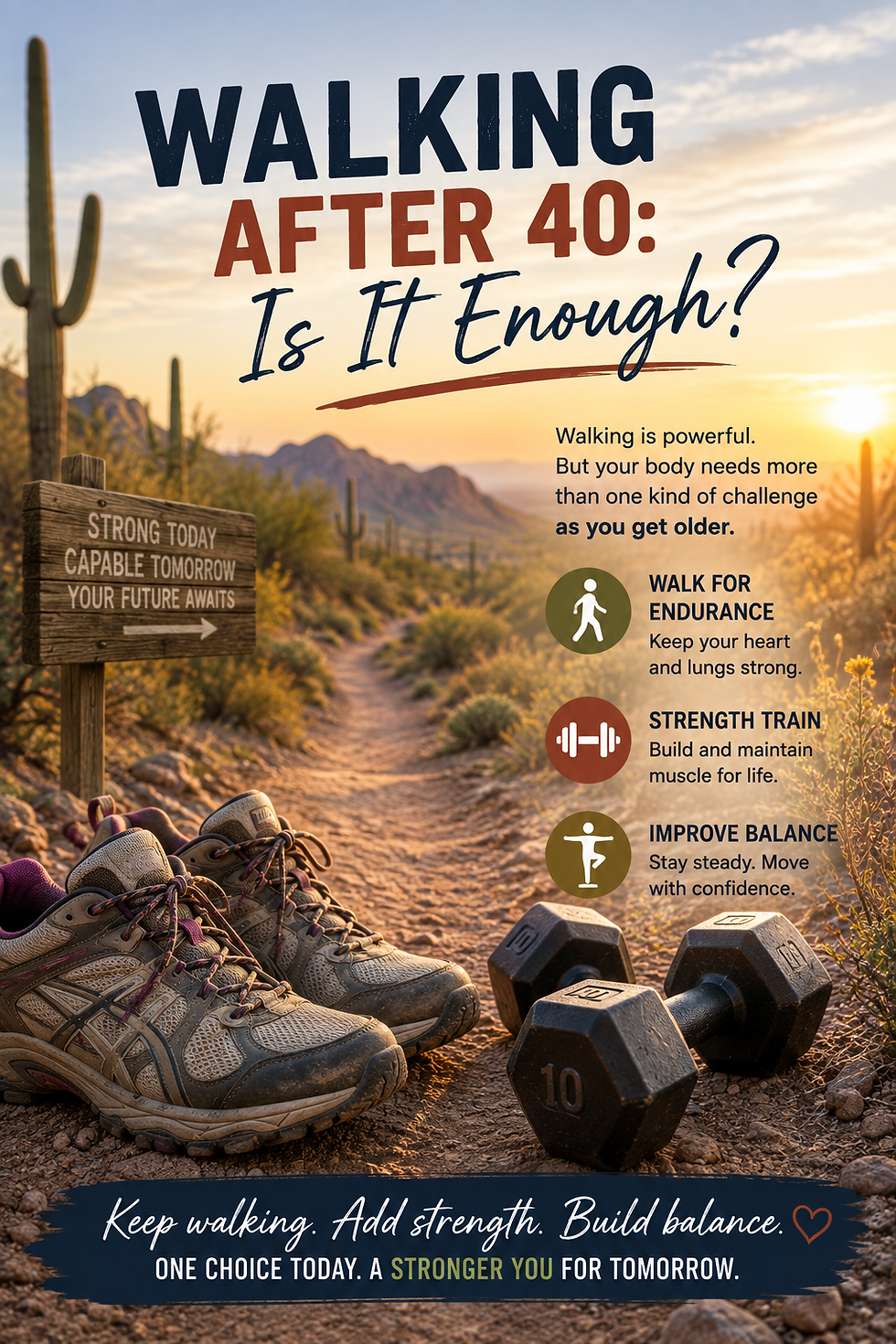
Walking is wonderful.
Hiking is wonderful.
Gardening is wonderful.
Keep doing them.
But if you want muscles to become stronger, they need an appropriate strength-building challenge.
Strength Training Doesn’t Have to Mean a Barbell
This is where some women stop before they ever begin.
They hear “strength training” and think:
That’s not for me.
But resistance can come from many places.
You might use:
Dumbbells
Resistance bands
Weight machines
Kettlebells
Body weight
Other forms of resistance appropriate for you
The equipment isn’t the important part.
Your muscles don’t care whether the resistance came from a fancy machine or a set of dumbbells in your living room.
What matters is that they’re being challenged appropriately and that the challenge can progress as you become stronger.
You don’t have to begin where someone else is.
You begin where you are.
And that’s not just beginner advice.
Individualizing the program to your goals, abilities and circumstances is part of good training.
What Does “Lift Heavy” Actually Mean?
You’ll hear this phrase a lot:
Women need to lift heavy.
There’s truth inside that statement, but it needs context.
“Heavy” isn’t one specific number — and heavier isn’t automatically better for every goal.
Resistance training works when your muscles are given an appropriate challenge. The amount of resistance, number of repetitions, sets and other training variables can then be adjusted depending on what you’re trying to accomplish.
For example, someone specifically training to maximize strength may use heavier resistance than someone whose primary goal is general fitness or muscular endurance.
And you don’t need to train until you physically cannot complete another repetition for your workout to be effective.
This is where progression matters.
As your body adapts, you gradually increase the challenge.
That might mean increasing resistance.
Or repetitions.
Or sets.
Or progressing the exercise itself.
The goal isn’t to prove how much weight you can survive today.
The goal is to give your body an appropriate reason to adapt for tomorrow.
Consistency Beats Complexity
This may be one of the best things to come out of newer resistance-training research.
Your program doesn’t have to be complicated to work.
You don’t need the perfect equipment.
You don’t need an elaborate training split.
And you don’t need to chase every new exercise you see online.
For most healthy adults, regularly performing resistance training matters much more than creating the world’s most sophisticated workout.
Doing something consistently beats designing the perfect program you never actually do.
Start.
Learn.
Progress.
Keep going.
What About Bone Health?
Muscle isn’t the only tissue affected by the demands we place on our bodies.
Bone health matters too.
Weight-bearing and resistance exercise are important components of supporting bone health as we age.
That’s especially relevant for women because lower estrogen levels after menopause contribute to more rapid bone loss and increased risk of osteoporosis.
Strength training isn’t a guarantee against osteoporosis, and women with osteoporosis, a history of fractures or other health concerns may need individualized exercise recommendations.
But exercise belongs in the conversation about protecting both muscle and bone.
Strength and Protein Work Together
This is why our conversation about protein came first.
Protein provides amino acids your body uses to build and repair tissues.
Resistance training provides the stimulus.
Think of it this way:
Protein provides some of the building materials.
Strength training gives your body a reason to build.
Neither needs to become complicated.
But together, they’re an important part of supporting strength and physical function as we age.
How Often Should You Strength Train?
Current U.S. physical activity guidance recommends that adults perform muscle-strengthening activities involving all the major muscle groups on at least two days each week, in addition to aerobic physical activity.
That doesn’t mean everyone should follow exactly the same workout.
Your starting point depends on your current activity level, experience, health, injuries, goals and abilities.
If you haven’t strength trained before, starting smaller and learning good movement patterns is completely appropriate.
You don’t have to destroy yourself in a workout for it to count.
In fact, you shouldn’t.
Soreness Isn’t the Goal
This one deserves to be said by a physical therapist:
Being sore isn’t proof that you had a good workout.
And being unable to sit down comfortably for three days isn’t a fitness achievement.
Some muscle soreness can occur when you introduce a new or more challenging activity.
But the purpose of training is adaptation — not punishment.
A good program balances challenge with recovery.
You should be building your capacity to live your life, not repeatedly exhausting yourself so much that you can’t live it.
Start With the Life You Want to Keep Living
Instead of beginning with:
What exercise should I do?
Try asking:
What do I want my body to continue being able to do?
Carry my own groceries?
Travel?
Hike?
Garden?
Get up from the floor?
Play with children or grandchildren?
Live independently?
Feel confident trying something new?
Now we’re training for something that matters.
Because your future strength isn’t built someday.
It’s being built through the demands you place on your body now.
Strong Isn’t a Look
This may be the biggest shift I want women to make.
Strength isn’t a body type.
It isn’t a clothing size.
It isn’t visible abs.
It isn’t how much weight someone else can lift.
Strength is capacity.
Capacity to move.
Capacity to respond.
Capacity to carry.
Capacity to recover.
Capacity to participate in your own life.
You don’t have to become an athlete.
You don’t have to love the gym.
You don’t even have to think of yourself as someone who “works out.”
Start where you are.
Challenge your body appropriately.
Give it the nutrition and recovery it needs.
Then gradually ask it to do a little more.
Your future deserves strength.
Let’s start building it.
⸻
Ready for Your Next Step?
You don’t need an advanced training program to begin building strength.
You need a safe, practical place to start.
→ Coming next: Strength Training After 40: A Beginner’s Guide to Getting Started
About the Author
Megan Fain, PT is a physical therapist, health educator, and founder of Power Reset Path. With more than 15 years of experience in healthcare, Megan brings a physical therapist’s perspective to movement, strength, recovery and lifelong physical function.
Her work focuses not simply on exercise, but on helping women build bodies capable of supporting the lives they want to continue living.
She founded Power Reset Path on the belief that every woman, at every age, has an innate power to transform the world around her. Sometimes we just need help seeing it.
A Note From Power Reset Path
This article is for education and general wellness information and isn’t a substitute for individualized medical or physical therapy care. Exercise needs and appropriate resistance can vary based on health, injuries, medications, bone health, experience and individual ability.
If you have osteoporosis, a history of fractures, significant pain, a medical condition that affects exercise, or concerns about your ability to exercise safely, talk with an appropriately qualified healthcare professional about recommendations specific to you.
References & Further Reading
American College of Sports Medicine (ACSM)
Resistance Training Prescription for Muscle Function, Hypertrophy, and Physical Performance in Healthy Adults: An Overview of Reviews (2026)
Updated evidence-based guidance regarding resistance training, progression, strength, muscle growth and physical function.
National Institute on Aging (NIH)
How Can Strength Training Build Healthier Bodies as We Age?
Information about age-related muscle loss and the role of strength training in maintaining muscle, mobility and physical function.
Centers for Disease Control and Prevention (CDC)
Adult Activity: An Overview
Current physical activity recommendations for adults, including muscle-strengthening activities for all major muscle groups on at least two days per week.
Office on Women’s Health, U.S. Department of Health and Human Services
Menopause and Your Health
Information about menopause, declining estrogen, bone loss and osteoporosis risk.
Office on Women’s Health, U.S. Department of Health and Human Services
Menopause Basics
Information about the menopause transition and health changes associated with lower hormone levels.


Comments